
আরও দেখুন


 17.11.2026 08:27 PM
The wave count on the 4-hour chart for EUR/USD has become more complex. On the higher timeframe (lower chart), the downward trend segment has taken the form of a five-wave A-B-C-D-E structure, which could be completed at any moment, as it appears to be fully developed. All waves within this segment are approximately equal in length, which is why this structure is considered corrective. If this assumption is correct, a new impulsive upward trend segment will begin to develop once the correction is complete, with targets well above the 1.2000 level.
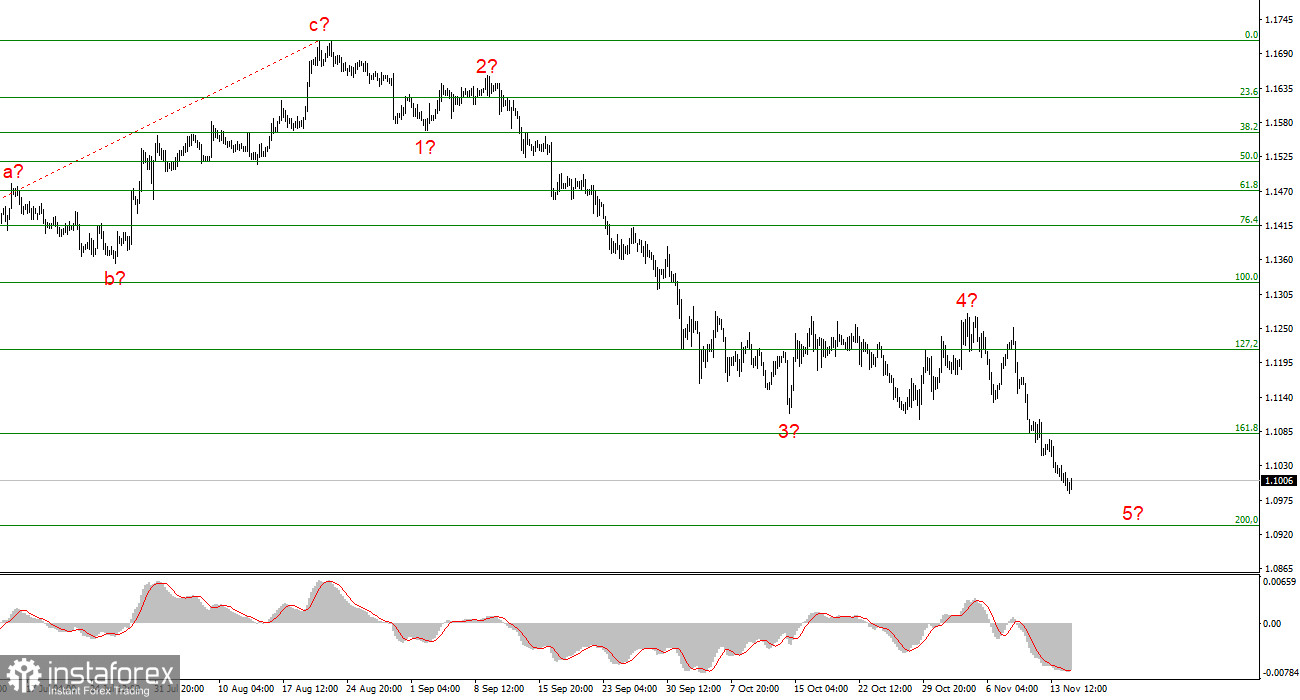
On the lower timeframe (upper chart), the development of an impulsive wave sequence continues, which may belong to wave E of the higher timeframe. If this is indeed the case, the US dollar's strengthening is approaching its end, regardless of how much further it appreciates. The anticipated wave 5 within wave E is nearing completion. In any case, the current wave structure suggests that the downward wave sequence is approaching completion on both charts. Economic news and a sharp shift in market sentiment have led to a substantial strengthening of the US dollar, but few new reasons for further dollar appreciation remain.
The EUR/USD exchange rate fell by another 15 points on Tuesday, and the European currency could lose another 30 points by the end of the day. Today's economic news could have provided moderate support for the euro and buyers, had buyers shown any willingness to open positions. Germany's ZEW Economic Sentiment Index came in at 35.6 points in November, compared with a forecast of 29.0. The corresponding index for the European Union reached 26.5 points, while market expectations stood at 19.1. These are certainly not the most important indicators, but the market has once again made it clear that developments in the European Union are of little interest to traders. At present, very few factors seem to attract their attention. There is little doubt that tomorrow most economists will once again state that hawkish expectations regarding the Federal Reserve's monetary policy have strengthened, which explains the US dollar's latest appreciation.
An interesting US retail sales report was also released today. Retail sales increased by 0.2% in October, in line with market expectations. However, if the ZEW reports are considered "not important enough," the retail sales report is treated as "important, with +0.2% being an excellent result." This appears to have been the reasoning of most traders when they opened further dollar-buying positions at the beginning of the US trading session. It is also worth noting that Kevin Warsh's speech yesterday provided the market with no new information. Nevertheless, some Fed policymakers continued to suggest that a more substantial increase in interest rates could be warranted if inflation dynamics deteriorate. The market appears determined to react to every Fed official's concerns, as though they were not all referring to the same central bank and its monetary policy. Overall, demand for the US dollar continues to increase, and most traders no longer even question the reasons behind its appreciation.
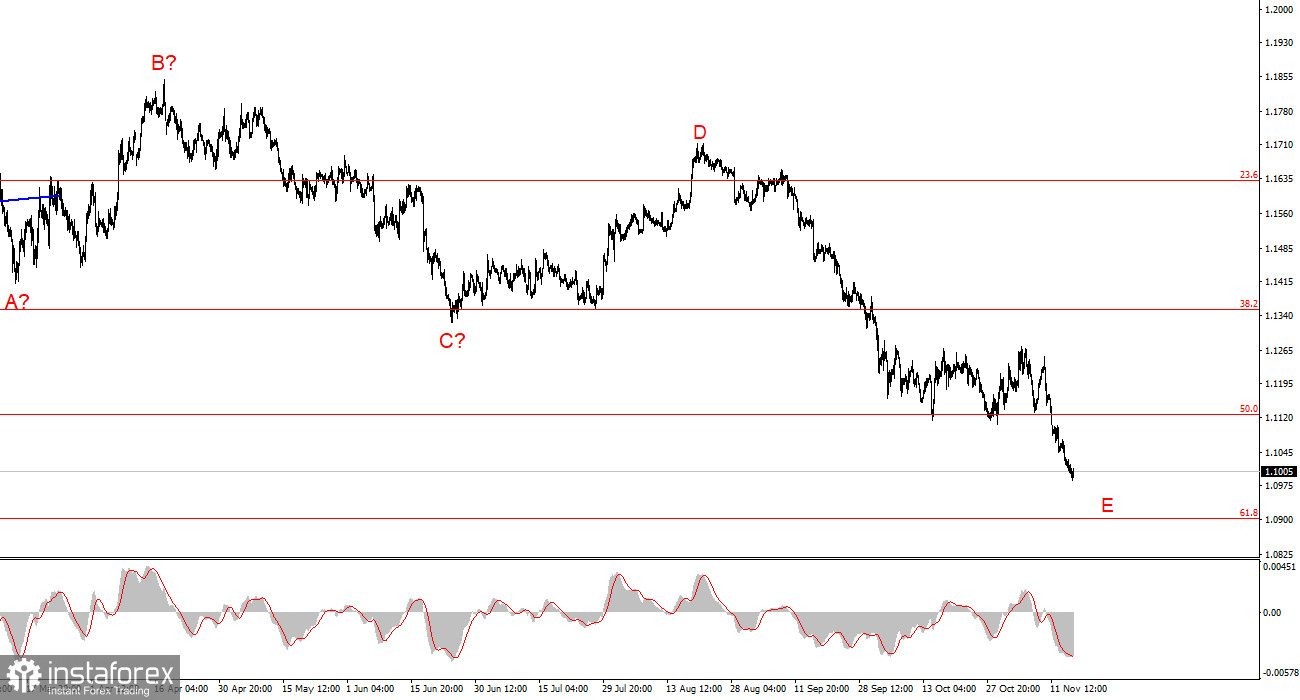
Based on the EUR/USD analysis, the conclusion is that the pair remains within the framework of a global corrective A-B-C-D-E trend segment. However, this structure appears to be fully developed and could be completed at any moment. In the current situation, this may be a favorable time not only to consider buying the European currency but also to anticipate the development of a full-fledged upward trend segment. According to the higher scale, growth should be expected to no less than 17-18 levels. The stronger the pair declines now, the stronger its subsequent advance could be. However, confirmation of the completion of the downward wave sequence is still required. One possible signal would be an unsuccessful attempt to break below the 1.0902 level, corresponding to the 61.8% Fibonacci retracement level on the higher timeframe.
The higher timeframe shows a downward trend segment that has taken the form of an A-B-C-D-E structure. The internal wave structure of wave E has developed into a five-wave impulsive pattern, which may already be complete. If this assumption is correct, a new upward trend segment will begin to develop in the near future.


