
यह भी देखें


 18.11.2026 07:51 AM
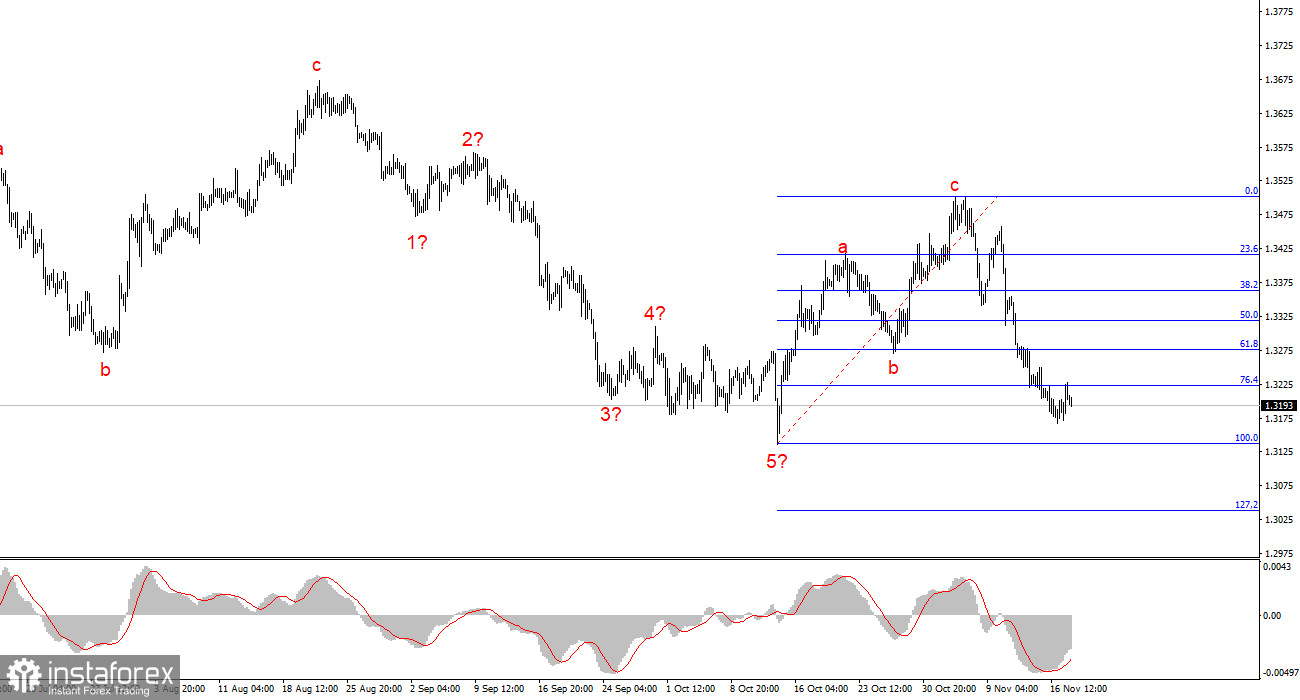
The wave count for GBP/USD continues to indicate the development of a sideways trend segment. The corrective A-B-C-D-E structure is presumed to be complete. If this is indeed the case, a new upward trend segment has begun to develop. However, the pound's latest decline, and particularly the decline in EUR/USD, makes it necessary to consider alternative wave count scenarios. It should be noted that no convincing alternatives to the current wave count are apparent. There are also no compelling reasons to expect the current trend segment to transform into a fully developed downward trend, with the prospect of further declines in 2027. Nevertheless, demand for the US dollar continues to increase, which could compromise the integrity of the current wave count.
On the lower time frame (top chart), a three-wave structure has emerged, which is corrective in nature. Consequently, the pair has moved on to developing a new impulsive wave sequence, and the downward momentum suggests that this is indeed the case. Accordingly, a new, fully developed five-wave structure can now be expected, with targets below the previous low of 1.3136.
The unemployment rate failed to impress the market.
GBP/USD rose by 20 basis points on Tuesday, which can reasonably be considered a miracle. In the EUR/USD analysis, it was noted that even on days when the European currency has every reason to appreciate by at least 50 points, it still declines or manages only a much smaller gain. The situation with the pound has been exactly the same over the past week and a half. For example, yesterday it became known that the UK unemployment rate had declined from 4.7% to 4.6%. A month earlier, it had fallen from 4.9% to 4.7%. Two weeks ago, the Bank of England raised its interest rate for the first time in several years, while GDP in the third quarter also showed positive growth. How did the pound react to all this information? It fell by 250 points. It is worth noting that in both unemployment-related cases, the market had expected more pessimistic figures. Meanwhile, in the case of the Bank of England, the market had not anticipated a unanimous decision by the Monetary Policy Committee (MPC) to raise interest rates. In other words, the information was not merely positive for the pound; the market had also been unable to price it beforehand, as it had anticipated a less favorable outcome.
Against this backdrop, today's inflation report, due to be released in a few hours, is a cause for concern. If inflation in the UK slows from its current level of 3.5%, there is little doubt that the pound will decline again. In that case, the market will lower its expectations for further monetary policy tightening by the Bank of England, despite forecasts that inflation will reach 5% next year. If inflation matches market expectations of 3.7%, demand for the pound may increase slightly, although probably not by much more than it did yesterday. If inflation exceeds 3.7% in October, the pound could post a more impressive gain, although it would still likely be relatively modest.
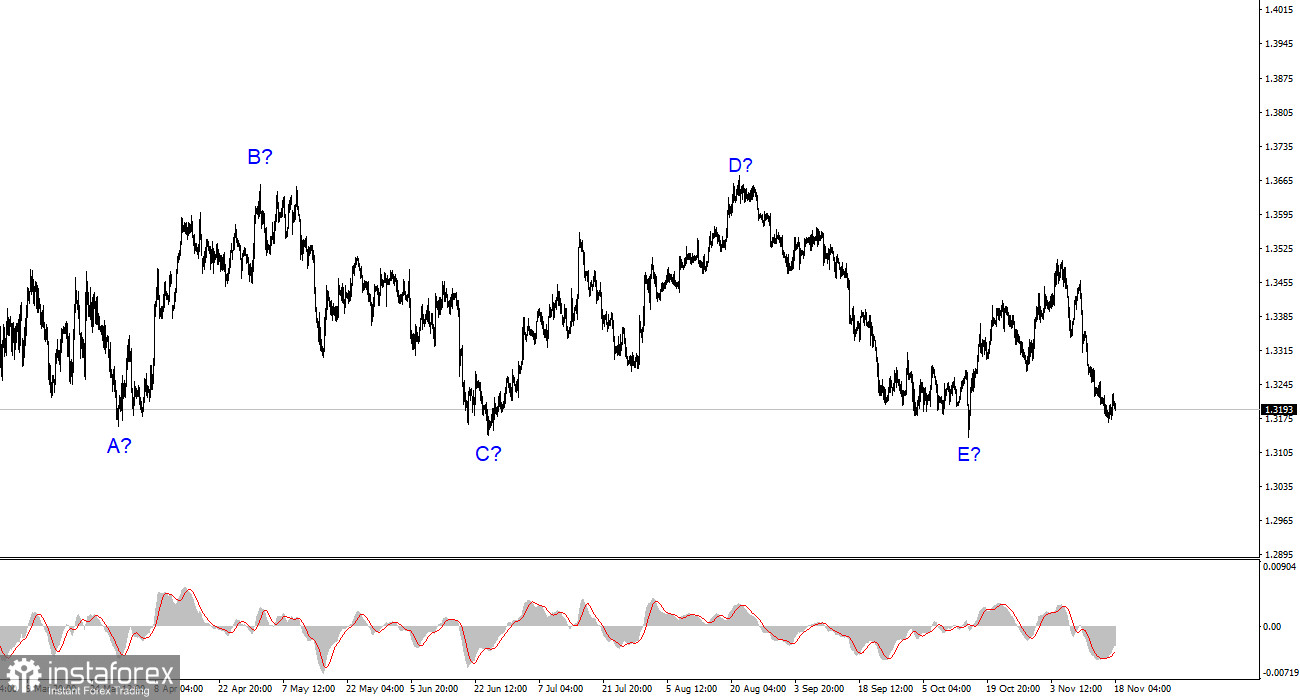
The wave structure for GBP/USD has become relatively clear. The higher time frame now shows a corrective A-B-C-D-E structure, which, logically, should already be complete. However, the lower time frame indicates that the downward wave sequence remains unfinished. Consequently, the pound's decline could continue toward the 1.3138 and 1.3039 levels, corresponding to the 100.0% and 127.2% Fibonacci levels, respectively. The further the pound declines, the more attractive long-term buying opportunities become.
The higher-time-frame wave count appears clear. The corrective A-B-C-D-E trend segment is either complete or will be completed in the near future. Of course, any trend segment can develop into a more complex and extended structure, but the most likely scenario is the one being considered here. For now, there are no reasons to expect another significant decline in the pound.
The main principles of the analysis:

