
Lihat juga


 19.11.2026 09:23 AM
Oil held near $92 as traders weighed the risk of a renewed escalation in the U.S.–Iran conflict. January Brent added 0.2% to $92.16/bbl, while December WTI eased 0.1% to $83.15. Caution was raised by reports that Trump is considering new strikes on Iran; he has not decided, and Israeli Prime Minister Netanyahu is reportedly urging a campaign of four to seven days.
Since October 30, when Brent reached $116.06, oil has fallen by more than one-fifth. It traded around $99.93 on November 6, $95.70 on November 13, and fell to $91.70 on November 17. The decline reflects a recovery of Middle East supply and Trump's decision so far to refrain from new large strikes. Downward pressure persists amid the supply surplus flagged by the IEA on November 13 — roughly 2 million b/d.

Risks, however, remain. Local clashes in the region have intensified recently; there have been a string of attacks on vessels in the Strait of Hormuz, and Iran has told neighbors to forbid the use of their territory for U.S. strikes — failure to do so would be, Tehran says, "an act of aggression" that would justify defensive measures. One of three U.S. carrier strike groups that had been enforcing a blockade near Iran left the Gulf and is likely returning to Japan after the Theodore Roosevelt group arrived on November 16.
At the APEC summit in Shenzhen today, Trump will meet Xi Jinping and Vladimir Putin, but he has said he will not ask them for help in a war with Iran. For the oil market, China is a bigger factor: demand is recovering faster than expected because lower prices encourage refiners to use import quotas and rebuild stocks. Several analysts have raised Q4 import forecasts to a 9.8–10.2 million b/d range.
Prices fell yesterday. U.S. crude inventories rose by 3.4 million barrels versus an expected 0.4 million and after a 4.657 million-barrel increase the week before; product stocks also rose. A pullback across commodities and a stronger dollar added pressure, and the Federal Reserve minutes showed most participants expect further rate hikes, with two members allowing for a step larger than 25 bps in December. Clearly, a stronger dollar and a hawkish Fed are headwinds for oil, even though supply risks in the Persian Gulf persist.
Overall, oil should stay in a narrow range while the market balances improving supply against the threat of new strikes. I expect Brent to trade in a $90–95 range in the coming sessions; Trump's Iran decision and the outcome of his meetings in Shenzhen will determine whether price can break higher.
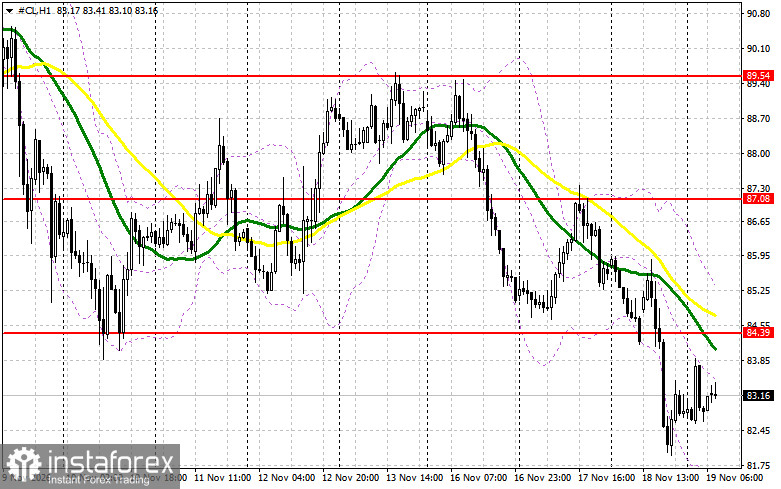
Technical picture
On the chart, buyers need to take the near resistance at $85 to target $87, above which a breakout will be difficult. The next upside target is around $89. On a decline, bears will try to seize control below $81. If they do, a range breakout would hit bulls hard and push oil toward $78, with scope to reach $74.


