
یہ بھی دیکھیں


 16.11.2026 07:51 AM
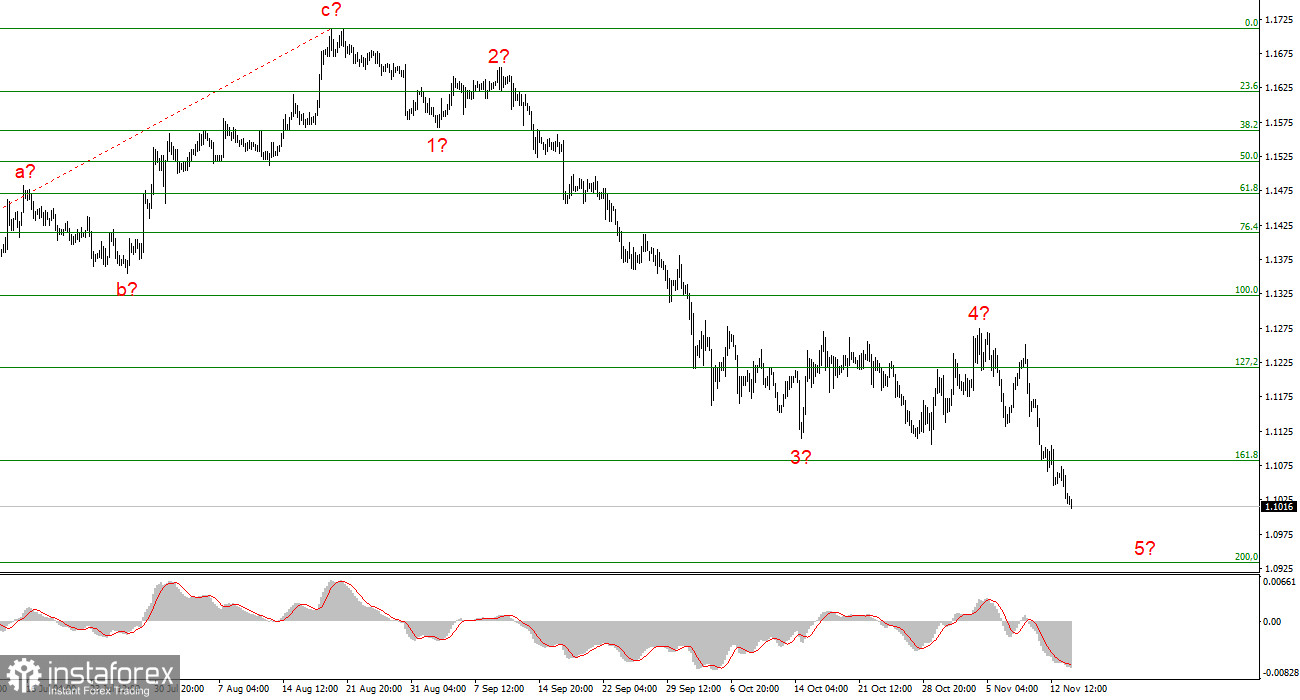
The wave count on the 4-hour EUR/USD chart has become more complex. On the higher time frame (bottom chart), the downward trend segment has taken the form of a five-wave structure A-B-C-D-E, which could be completed at any moment, as it appears structurally complete. All waves within this segment are approximately equal in size, which is why it is considered corrective. If this assumption is correct, the completion of this structure will be followed by the development of an impulsive upward trend segment, with targets located well above the 20.00 level.
On the lower time frame (top chart), the development of an impulsive wave sequence continues, which may belong to wave E of the higher time frame. If this is indeed the case, the dollar's strengthening is approaching its end, regardless of how strongly the US currency continues to rise. The expected wave 5 within wave E is nearing completion. In any case, the current wave structure suggests that the downward wave sequence is approaching completion on both charts. News developments and a sharp shift in market sentiment have led to a significant appreciation of the US dollar, but there are few new reasons left for further dollar strength.
Monday promises to be interesting.
The EUR/USD exchange rate declined by another 30 basis points on Friday, with the downward movement continuing almost uninterrupted. The new trading week has not even begun, yet the euro is already declining. Therefore, it is already possible to assess market sentiment following the weekend. Market participants currently appear to have no need for pauses or periods of consolidation. The US dollar continues to appreciate, so why not keep buying it regardless of the news flow?
Today, FOMC Chairman Kevin Warsh is scheduled to speak in the United States. This event could trigger another round of dollar buying. It is worth recalling that Mr. Warsh rarely addresses the Federal Reserve's monetary policy and never comments on the US central bank's future decisions. However, the market finds a way around this lack of guidance. It interprets the FOMC Chairman's stance independently and draws its own conclusions. At times, these interpretations can become excessive. Warsh may say nothing particularly significant about the economy or monetary policy, yet the market may still interpret his remarks as evidence of a hawkish central bank stance. Therefore, the same situation could arise again today.
In the most favorable scenario for the euro, Warsh will avoid discussing inflation, the economy, or the Fed's monetary policy. However, if the Fed Chairman refers to the latest GDP report and highlights the strength of the US economy, the dollar could rise again. If Warsh comments on the latest inflation report, which showed an acceleration in inflation, the dollar could also strengthen. Any remark could trigger further dollar buying, which is continuing even in the absence of Warsh's speech. The lower-time-frame wave count now suggests the development of wave 5, which could take a five-wave form. Consequently, the decline could continue this week, with a target at 1.0933, corresponding to the 200.0% Fibonacci level.
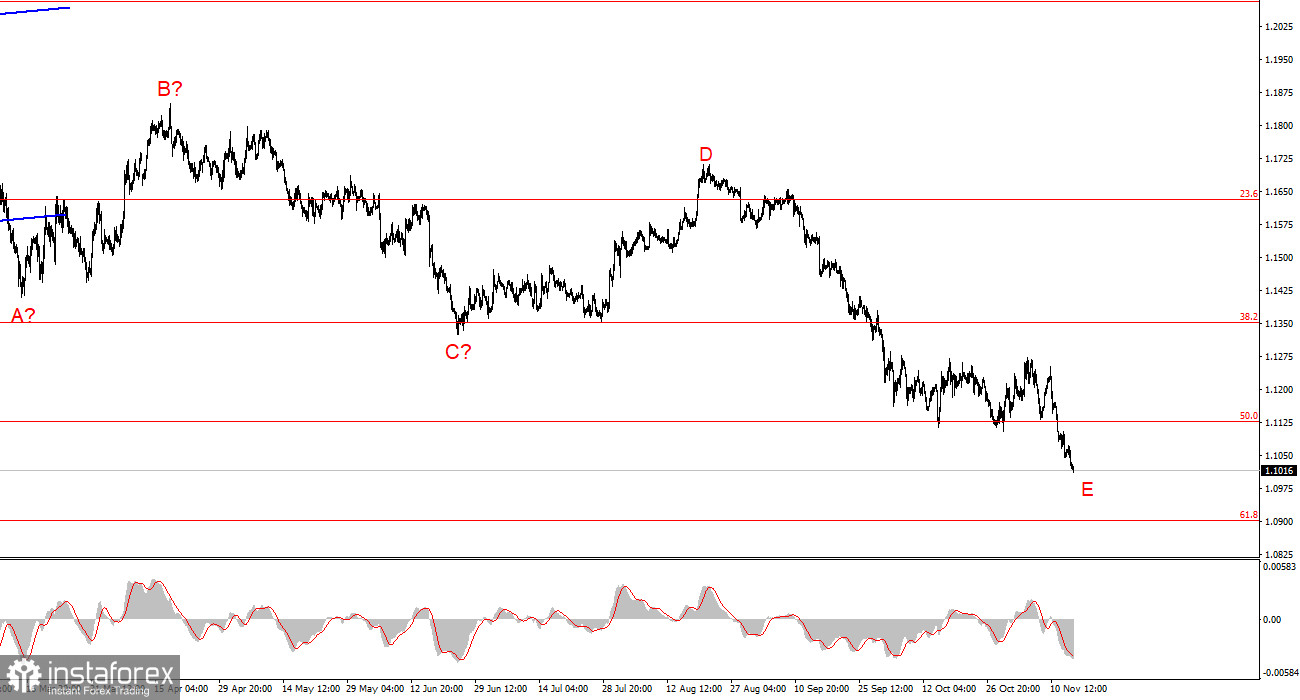
Based on the EUR/USD analysis, the pair remains within a global corrective trend segment A-B-C-D-E. However, this structure appears complete and could end at any moment. In the current situation, there may be a good opportunity not only to buy the euro but also to anticipate the development of a full-fledged upward trend segment. According to the higher time frame, the pair is expected to rise by at least to the 1.1700–1.1800 level. The stronger the pair's current decline, the stronger its subsequent advance could be. However, confirmation that the downward wave sequence has been completed is still required. One possible signal would be a failed attempt to break below 1.0902, corresponding to the 61.8% Fibonacci level, on the higher time frame.
The higher time frame shows a downward trend segment that has taken the form of an A-B-C-D-E structure. The internal wave structure of wave E has developed into a five-wave impulsive pattern, which may already be complete. If this assumption is correct, the development of a new upward trend segment could begin soon.
The main principles of the analysis:


