
Vea también


 13.11.2026 12:50 PM
The euro is barely moving today, and the reason is clear. The market is waiting for important US economic data and is in no hurry to open large positions. The modest increase that did occur was driven by the upward revision of eurozone GDP for the third quarter. GDP represents the total value of goods and services produced by an economy. The preliminary estimate released on October 30 showed quarterly growth of 0.4%, against a forecast of 0.2%, while growth in the second quarter stood at 0.6%. The figure has now been revised upward to 0.6%, bringing economic growth back to the second-quarter level. Annual growth was confirmed at 1.3%.
The remaining figures were weaker. Employment increased by 0.1%, against a forecast of 0.2%, while the trade deficit widened to 8.7 billion, compared with the expected 4.5 billion. The deficit was initially estimated at 6.8 billion and subsequently revised to 7.8 billion. Thus, instead of narrowing, it continued to widen. This means that one positive report was offset by two negative indicators, and this combination is insufficient to generate a sustained upward movement in the euro.
The main event is still ahead, and it concerns the US dollar. The US Producer Price Index (PPI), which measures the prices businesses receive for their goods, will be released today. In September, the index increased by 1.3% month over month, its largest rise since March 2022, against a forecast of 0.5%. At the time, the dollar received only temporary support. This time, the monthly increase is expected to slow to 0.4%, while the annual figure is forecast at 6.6%, compared with 6.3% previously.
Particular attention is also being paid to the index excluding food and energy prices, commonly referred to as core PPI. It excludes the most volatile price components to provide a clearer picture of underlying price trends. In September, it increased by 0.7%, while the forecast for October stands at 0.3%. US consumer inflation has exceeded forecasts for three consecutive months, supporting the dollar after each release. If producer prices also come in above expectations, the dollar could strengthen further, and the upward revision to eurozone GDP may not prevent the euro from resuming its decline.
Following the release, Susan Collins and Michelle Bowman will speak, followed by Mary Daly. Collins previously described interest rates as moderately restrictive, meaning that they were slowing economic activity without applying excessive pressure. Until recently, Daly considered monetary policy to be in a good position, but yesterday she stated that further tightening would be necessary. This represents a notable shift in her rhetoric. Interest rate futures are pricing in 25-basis-point Fed rate hikes in December, January, and March.
EUR/USD is currently trading near 1.1056, within a range between 1.1036 and 1.1069. A move beyond either boundary is considered a breakout, but a brief test of a level is not sufficient. The price needs to consolidate beyond it, meaning that several consecutive five-minute candles must close above or below the relevant level. Otherwise, traders risk encountering a false breakout, after which the price may return to the previous range.
The upper resistance level is at 1.1069. Consolidation above it would open the way toward 1.1102 and then 1.1133. The price has already risen to 1.1073, slightly above this level, but failed to hold there. This is an important sign of weak buying pressure. The first target at 1.1102 is close to the upper boundary of yesterday's rebound near 1.1100, where selling pressure often emerges. The upward revision of eurozone GDP to 0.6% is positive, but employment growth came in below expectations, while the trade deficit of 8.7 billion was almost twice the forecast of 4.5 billion. Therefore, this scenario appears unlikely.
The lower reference level is 1.1036. Consolidation below it would open the way toward 1.1004 and then 1.0973. This is considered the primary scenario. Over the past three days, the pair has moved from 1.1138 through 1.1098 to its current level near 1.1056, while yesterday's rebound failed to gain momentum. The US PPI will be released today, with a monthly increase of 0.4% expected following September's 1.3% rise. If the figure exceeds expectations and Daly reiterates yesterday's statement about the need for further monetary tightening, the dollar could receive another boost. Approximately 20 pips remain before the next key level, while the low near 1.1046 must be broken first. If the price moves below this level and consolidates there, the decline could accelerate. Entering a position on the first test of the level is not advisable.
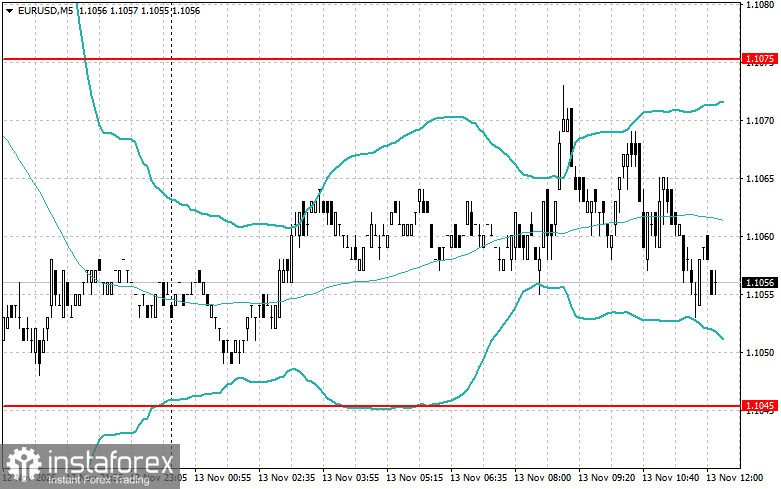
Two levels are important here: 1.1071 and 1.1045. The upper reference level of 1.1071 is just two points above the breakout level for long positions at 1.1069, so particular caution is required. The same area serves both as a potential signal for further upside and as a reference point for a possible reversal to the downside. It is impossible to determine which scenario is developing based on the first test alone.
If the price consolidates above 1.1071, the upward breakout scenario is confirmed, and short positions should be avoided. However, if the price reaches 1.1071, fails to continue higher, and quickly returns below it, short positions could be considered toward 1.1045, with a stop-loss above 1.1077 and a small additional buffer. This scenario is more likely if the PPI comes in close to expectations and the market begins to retrace after its initial reaction. The distinction between these two scenarios may become clear within just a few minutes, so it is preferable to avoid trading the initial reaction around this level.
The lower reference level of 1.1045 is nine points above the breakout level for short positions at 1.1036 and almost coincides with the low of the past 24 hours near 1.1046. This indicates that buyers have already entered the market in this area. The strategy is as follows: the price declines toward 1.1045, fails to consolidate below it, and moves back above the level. In this case, long positions could be considered toward 1.1071, with a stop-loss below 1.1036 and a small additional buffer. Such a rebound is likely if Fed officials refrain from making further hawkish comments and the market begins taking profits toward the end of the week. However, if the price consolidates decisively below 1.1036, the rebound scenario is invalidated, and the downward breakout scenario takes precedence.


