
यह भी देखें


 20.11.2026 08:55 AM
After yesterday's session, the euro recovered in the first half, and the pound made a similar attempt to rally, but the move was driven not by data but by market hopes that dollar demand would ease slightly and risk assets would see a correction. There were no major releases for the eurozone or the UK, so the move was modest and largely technical.
ECB speeches supported the euro yesterday. Joachim Nagel said rates need to rise: inflationary pressures have not yet produced second-round effects but could at any moment, so they must be fought even as oil and energy prices fall, because no one wants a repeat of past European gas crises. It is noteworthy how the Bundesbank chief's rhetoric has shifted. On October 16 he only said new steps could not be ruled out; now he calls a December hike a firm signal of resolve and allows for continuation afterward. Fabio Panetta added that the regulator must prevent inflation from becoming entrenched while trying not to do excessive harm to the economy, calling the two hikes already made (June and September) "moderate."
Why did such tough words not translate into a confident euro rally? Because a rise in the deposit rate from 2.50% to 2.75% on December 17 is already priced in, and the market needs forward guidance for 2027—which the Governing Council does not want to provide.
Fed speakers also helped the dollar yesterday. Anna Paulson emphasized the importance of clear communications on the economy and rate expectations; recall she voted to hold in October but on November 10 said the pause concerns pace, not direction, and that further tightening is appropriate. The October minutes published last week showed this is not a lone view: nearly all participants believe another hike will be required, and two even allowed for more than a 25-bp step in December.
A second source of dollar demand is equities. Anthropic's listing, one of the largest in history, initially jumped at the open but then lost more than 5%. The company aimed to raise about $90bn at a $1.4trn valuation, and demand exceeded supply almost sevenfold, so the market reaction looks like disappointment. I would suggest the IPO failed to remove doubts about the AI sector's returns—consistent with the Fed minutes, where participants highlighted the risk of investor disappointment in AI's payoff and rising debts at such companies. A further large sell-off could turn panic-like, and, on such days, the dollar acts as a safe haven.
Turning to today, let me start with the morning where the focus is on U.K. retail sales for October. A flat result is forecast after a -0.4% print in September (which was worse than the -0.1% forecast), and core retail sales fell -0.7%. For the pound it matters whether consumer weakness is confirmed: a better-than-expected print would partly support the currency, which continues active selling versus the dollar; a miss would add arguments to those who see demand as a weak link following inflation's rise to 3.6% in October. Next the German PPI for October will be released—forecast +0.9% after +1.9% in September, when the annual rate reached 6.7%. A halving of the monthly pace is priced in, so the market will watch for an upside surprise, which would strengthen the case for a tougher ECB and help the euro hold current monthly lows. Note that Germany's wholesale prices for October rose +0.4% (in line with forecast), so no acceleration signal was present. Lagarde will also speak, but she has already spoken several times this week, so new signals are unlikely.
In the US, data on the Michigan consumer sentiment index for November is the main focus. Inflation expectations are forecast at 4.3% versus 4.7% in October, and the sentiment index at 51.0 versus 48.0. Both match preliminary readings on November 6, so the market expects confirmation of recovery after the dip. If the readings beat forecasts, given the overall backdrop and market conditions, the dollar can easily continue to strengthen versus the euro and the pound, and higher inflation expectations would add weight to calls for a 50-bp move. In the afternoon Fed governor Christopher Waller will speak, and after his November 18 remarks I expect him to reiterate the point that inflation is moving in the wrong direction. The picture is clear: supporters of further hikes speak in nearly every appearance, and that has been the main driver of the dollar in recent weeks.
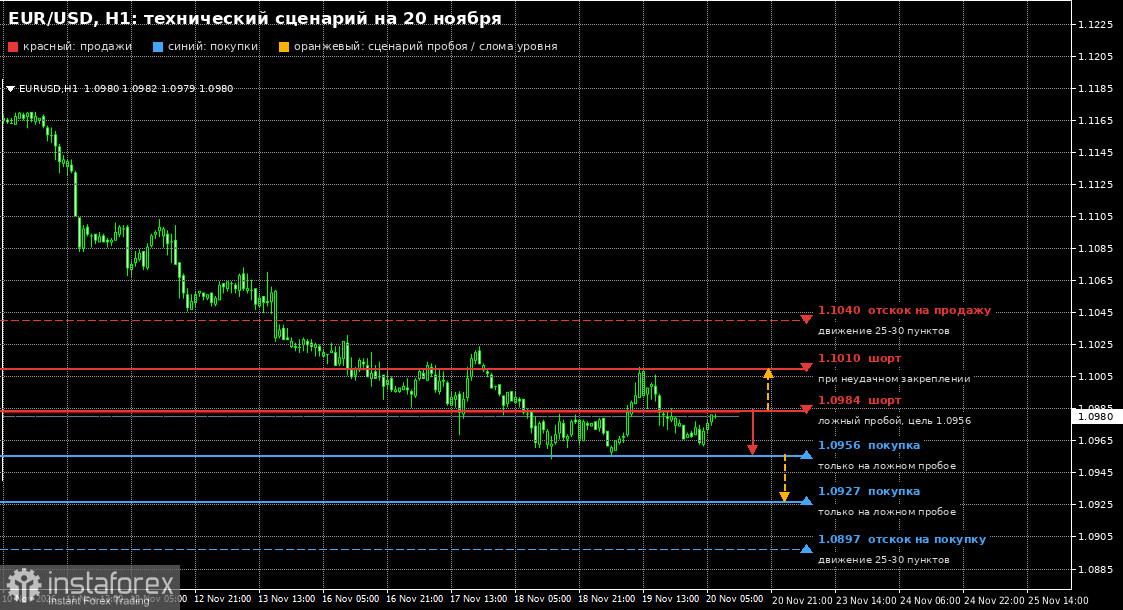
Technical picture for EUR/USD (1H): the pair remains in a sideways corrective channel whose midpoint runs near 1.0984. Only a false break of that level would be a reason to open new short positions aiming for a return to 1.0956. A third test of 1.0956 could end in a breakout and intensify pressure on the euro, opening the road to 1.0927 and 1.0897, where I will buy the bounce for 25–30 pips; longs from 1.0956 and 1.0927 are possible only on false breaks, since that is counter trend and warrants caution. If bulls do take 1.0984, expect a larger move to the 1.1010 area, where I expect sellers to show only on a failed close above, and I would sell bounces from 1.1040 for 25–30 pips. Compared with the prior session the upper targets shifted down: the sell-on-bounce level used to be 1.1047 and the channel midpoint around 1.0989, while the lower levels 1.0956, 1.0927 and 1.0897 remain.
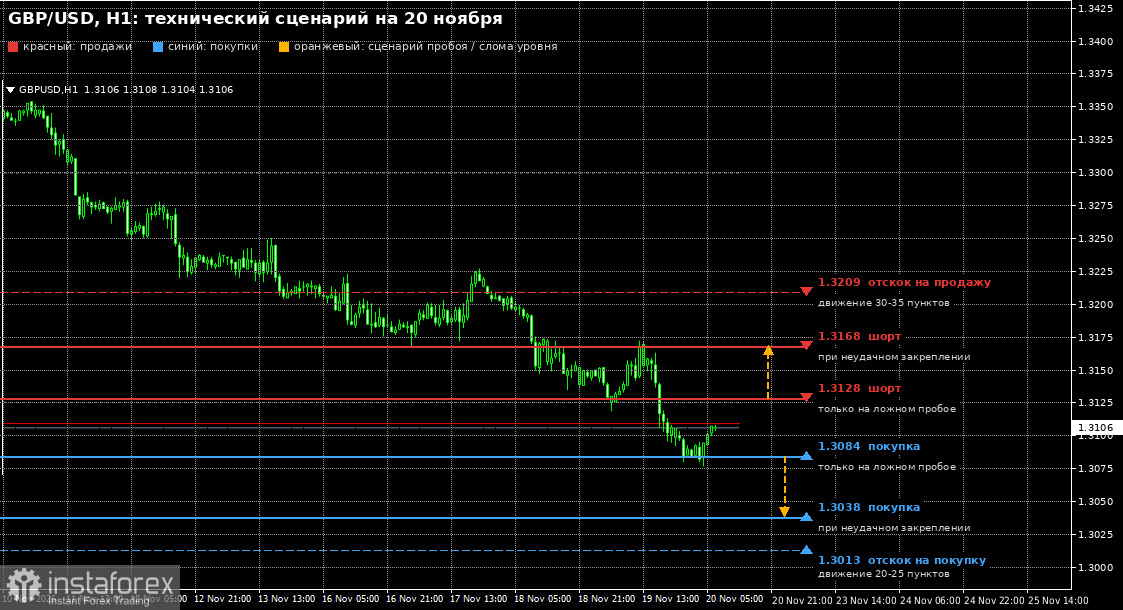
GBP/USD: the pound continues actively falling, and I expect the first bear move after any upside correction to come on strong UK retail sales. A false break of 1.3128 would be a cue to scale into shorts and continue the downtrend. If that fails, short entries await at 1.3168 on a failed hold, and I will sell the bounce from 1.3209 for 30–35 pips. Buy setups against the downtrend require caution: possible signals are a false break of 1.3084 or a further drop to 1.3038 and 1.3013, where longs could be taken on failed closes and bounces limited to 20–25 pips intraday. All benchmarks shifted 15–35 pips lower from the prior session, when sell-on-bounce began at 1.3224 and the lower buy zone was at 1.3038.
The bottom line: the picture is not favorable for euro and pound buyers. 10-year U.S. yields exceed 5%, Fed officials are discussing a 50-bp step, and the ECB, despite Nagel's tough words, promises nothing beyond December—so any euro bounce on current data will likely remain a correction inside the sideways downtrend. The pound has one recovery trigger—retail sales—and a weak print will resume the slide quickly, while a strong print would meet resistance at 1.3128 and 1.3168. I do not exclude that equities will determine the outcome: a new sell-off in AI stocks will boost dollar demand more than any single print. Ahead of the Fed (9 December) and ECB (17 December) meetings, I expect the downtrend in both pairs to continue with brief retracements.

