
Vea también


 19.11.2026 11:18 AM
The euro continued to weaken against the US dollar, and the same trend was seen in the British pound. By Thursday morning, EUR/USD had fallen to 1.0964 from 1.0990 on Wednesday morning and GBP/USD to 1.3132 from 1.3197. There is nothing surprising in this: in the first half of the day, attention was focused on inflation in the eurozone and the UK, and the data offered no support to either currency.

What do the eurozone figures show? The year-on-year consumer price index for October was 4.0%, matching the preliminary estimate and up from 3.8% in September; month-on-month growth accelerated to 0.5% versus a forecast of 0.4% and 0.6% a month earlier, and the core measure stood at 2.6% against an expected 2.5%. I remind you that inflation was 3.2% in August and 2.1% a year earlier — so prices are rising much faster. That pressure creates difficulties for the ECB, which still needs to go ahead with rate hikes: the deposit rate is currently 2.50%, and a step to 2.75% is expected on December 17. However, the December increase is already priced in, and the euro gained no support from the data.
Likewise, the pound sterling did not rally on the inflation print. The UK year-on-year rate jumped to 3.6% from 3.5% in September, in line with forecasts, and month-on-month prices rose 0.5% versus 0.4%. Again, this is a year-on-year increase and remains far from the Bank of England's 2% target. Notably, in September the index came in above the 3.4% forecast and the pound sterling rose then, but now there was no reaction. Producer input prices, by the way, rose 2.2% month-on-month versus a forecast of 0.8% and 1.5% previously, yet the Bank of England's 4.00% rate after the 9–0–0 decision did not strengthen the pound sterling. In my view, the explanation is that the economy is starting to show signs of slowing: average pay, including bonuses, slowed to 3.6% from 3.8%, Rightmove house prices fell 1.8% in November after rising 1.0%, and rate hikes will weigh on that market. The pound sterling is reflecting all this against a fairly strong dollar.
Yesterday, the minutes of the October Fed meeting were published, and traders bought dollars in response. They were tougher than the meeting's outcome, where the funds rate was left unchanged in a 10–2 vote, and only Hummock and Cook voted for a 25 bps hike. But the minutes show that almost all participants see another hike as necessary to bring inflation back to 2%, and two members allowed for a larger-than-25-bps step as soon as December if inflation data disappoint. Many officials spoke of continuing hikes both at the time and immediately after the meeting and over the past two weeks. The December move is now fully priced in, and the dollar is strengthening on expectations of increases in January and March. There are no signs of a reversal: yields are rising, demand for the dollar persists, and even a fall in oil does not remove the inflation problem that forces the Fed to act.
As for today, in the first half of the day, eurozone current account balance data for September are expected, with a forecast of €16.6 billion after €8.7 billion in August, when the print was much lower than expected, and the euro fell. From UK statistics, the CBI industrial orders balance for November will be released, forecast at -29 after -32 in October, when it disappointed versus an expected -20. No other major European data are due; the Bundesbank publishes its monthly report, and then ECB President Christine Lagarde will speak. She previously stressed that the council discussed hikes but would check new data before December, and last week she preferred not to touch on rates at all. If her remarks address future policy, the euro could get support and strengthen versus the dollar. Otherwise, there are simply no reasons for growth today, even based on fundamental statistics.
In the US, weekly initial jobless claims are due: 198,000 expected versus 200,000, and continuing claims are forecast at 1,710,000 versus 1,697,000 — i.e., within normal ranges. Euro buyers should not expect much. The Philadelphia Fed manufacturing index will also be released: forecast 20.6 versus 20.9 last month. Speeches are scheduled from Beth Hammack, Austan Goolsbee, and Michael Barr. On November 5, Hammack spoke of more frequent small steps and on the 16th allowed for larger moves and a higher terminal rate; Goolsbee on the 9th called AI-driven construction a demand overheating and on the 10th described the inflation report as worrying; Barr has previously said he is prepared to raise rates. We heard all that this week, so further comments will help strengthen the dollar and push down the euro and pound.
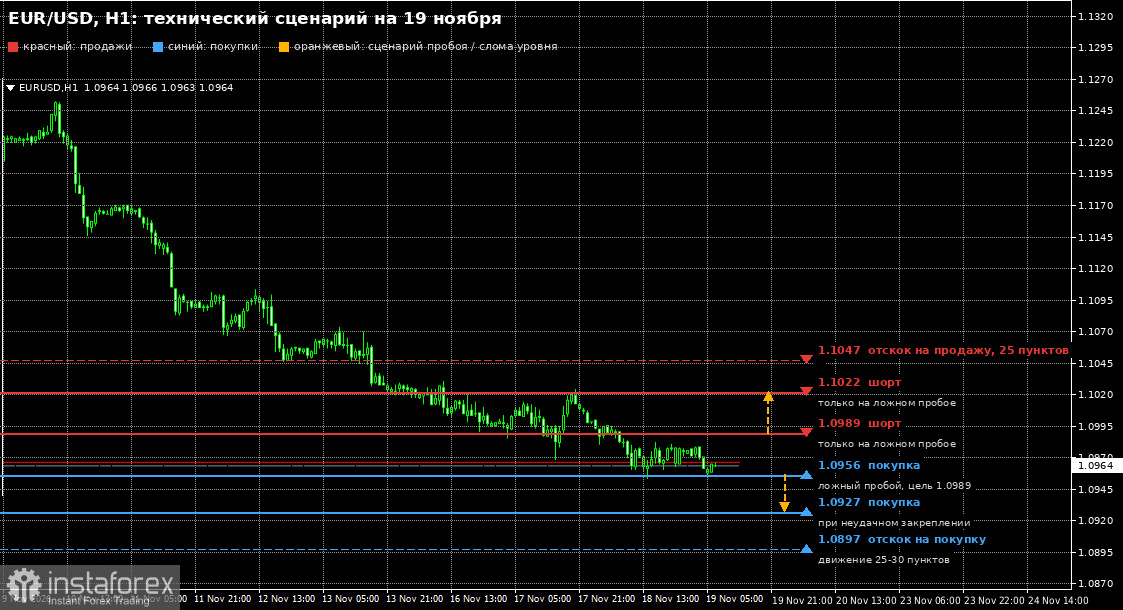
Technical picture for EUR/USD
On the hourly chart, support for buyers is at 1.0956 — the formation of a false breakdown would be a reason for a recovery toward roughly 1.0989. Only a breakout with a close and trading above that level would give momentum toward 1.1022, with a further target at 1.1047, where I will look to sell on a rebound with a 25-pip move. Short positions on retracements along the trend from 1.0989 only on a false breakout, likewise from 1.1022 only on a false breakout. If bears manage to push and trade below 1.0956, that would increase downward pressure and open the way to 1.0927. Buys there would be counter-trend on a failed hold, so one should be cautious. A further target would be 1.0897, where I will look to buy on a rebound for 25–30 pips.
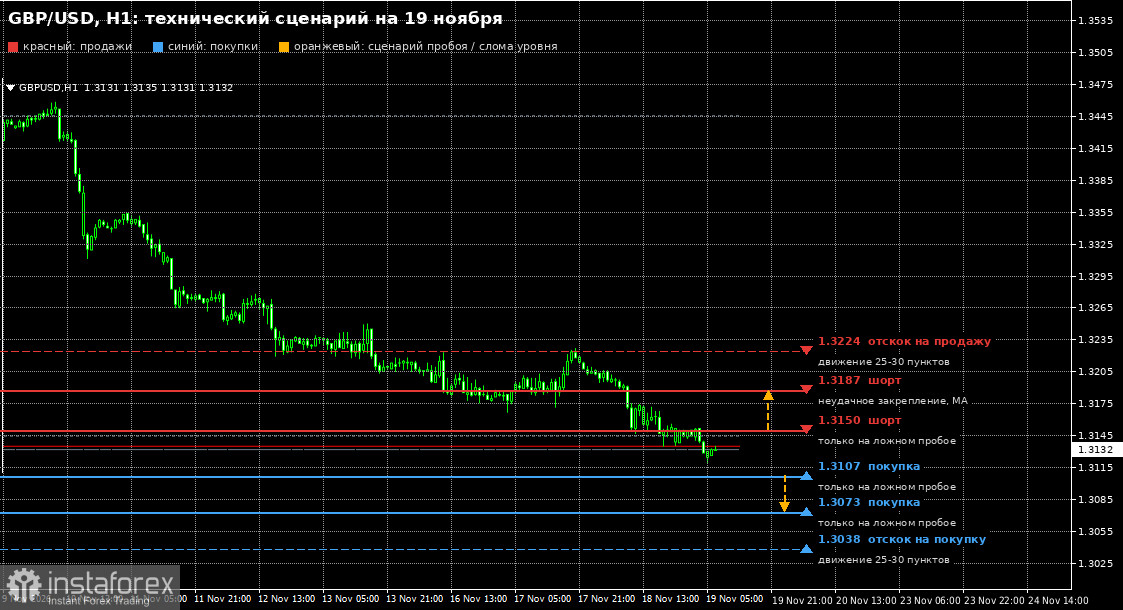
GBP/USD shows a similar story. If you want to buy, it's best to wait for a drop to 1.3107. Given the lack of any important statistics today, the pound may show an upside correction. But buy only from 1.3107 on a false breakout or on a false breakout from 1.3073; on a rebound, I will look at 1.3038 for 25–30 pips. For sell positions, I expect the first bearish reaction in the 1.3150 area — I will act there on a false breakout. If the upside correction gains a larger impulse, consider selling to 1.3187 on a failed hold and from moving averages, or shorting on a rebound from 1.3224 for 25–30 pips.
The bottom line for the day is clear. The US dollar remains the winner while the market prices in three Fed moves, and the hawkish minutes and expected remarks by Beth Hammack, Austan Goolsbee, and Michael Barr only reinforce that path. I lean toward the view that the euro has no upward foothold, so any rebound to 1.0989 will primarily serve as a selling opportunity. The pound could show an upward correction in the absence of UK statistics — I do not rule it out — but in my view, without a shift in the Fed's tone, it will remain a correction inside a downtrend.


